How to Build Content for Search and AI Discovery
A practical guide to creating pages that rank in search, get cited in AI answers, and compound into a useful content system.
Treat search and AI answers as one content problem
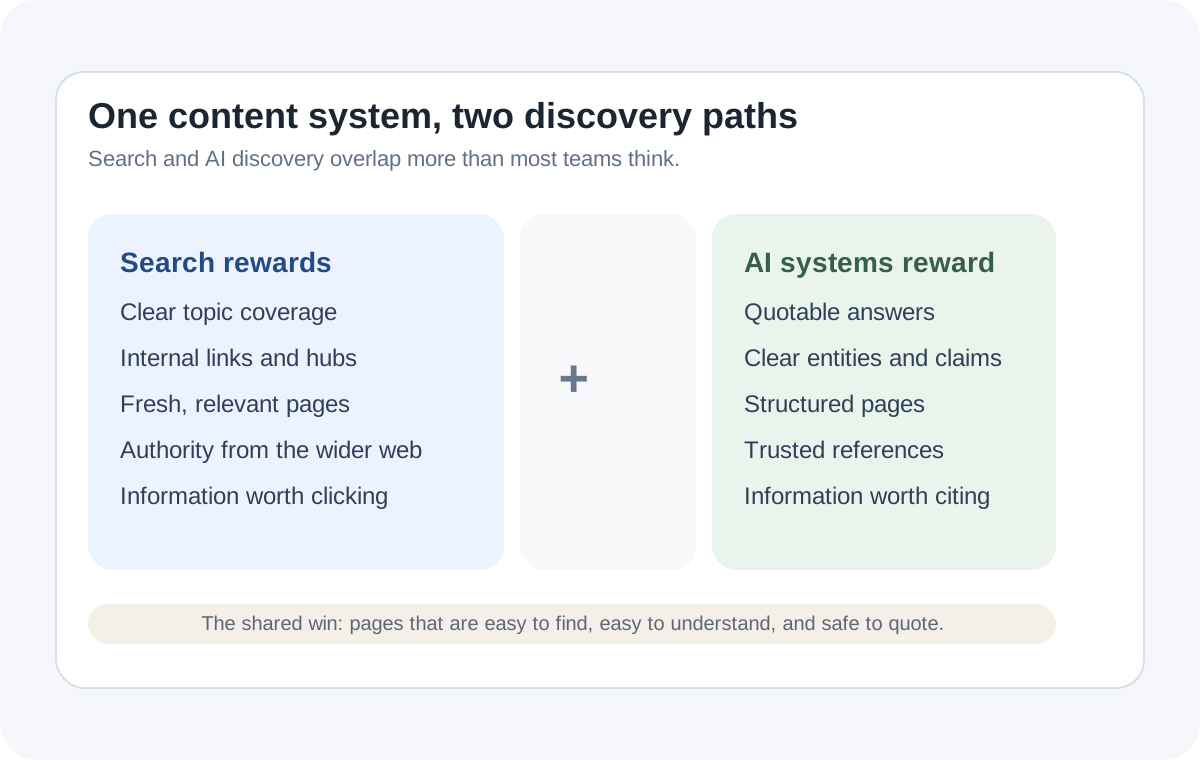
Search engines and AI assistants are different products, but they reward much of the same work. Both need clear pages, strong topic coverage, useful structure, and information that looks safe to quote. If your content is vague, thin, or hard to parse, it usually underperforms in both places.
That is why the more useful question is not 'should we do SEO or GEO?' but 'what kind of site becomes easy to find, easy to understand, and easy to cite?'
Start with pages that explain themselves quickly
Good content does not take a long time to become legible. The title should name the topic plainly. The opening should answer the obvious question early. The rest of the page should deepen the answer instead of circling around it.
This matters more now because AI systems often work by extraction. If the clearest explanation sits halfway down the page, you are making it harder for both people and machines to carry the right idea forward.
Build collections, not isolated posts
One-off posts rarely compound on their own. Collections do. A glossary supports guides. Guides support comparisons. Comparisons support decision-stage traffic. Statistics pages create citation targets. Question pages capture the way buyers actually phrase a problem.
- Glossaries are useful for definitions, internal links, and short quotable answers
- Guides are useful for core category education and evergreen search demand
- Comparisons are useful for high-intent visitors already weighing options
- Statistics and research pages are useful for citations, links, and authority
The aim is to build a content layer where each page has a clear job and strengthens nearby pages, not to flood the index with pages.
Original data is still the cleanest advantage
Opinion can help with positioning, but original data is what tends to earn references. If you can publish recurring benchmarks, trend reports, source patterns, or category observations that nobody else has, you give the web something concrete to cite.
That matters for classic SEO because original research attracts links. It matters for GEO because AI systems are more likely to lean on pages that say something specific rather than repeating a generic take.
Make pages easy to quote
A lot of strong content underperforms because it is harder to quote than it should be. The insight may be good, but the page hides it behind branding language, filler, or long windups.
- Write the strongest definition early
- Use headings that sound like real questions
- Keep one short summary sentence near the top of each section
- Support claims with examples, numbers, or visible sources when possible
- Make sure the core facts appear in crawlable text, not only in visuals
Authority still comes from outside your site
Internal structure helps a page get understood. Outside validation helps it get trusted. Review sites, industry publications, partner ecosystems, and credible communities all contribute signals that your site cannot manufacture alone.
That is one reason GEO and SEO still overlap so heavily. Both are stronger when the rest of the web agrees that you belong in the conversation.
Measure beyond rankings
Rankings still matter, but they are not the whole story anymore. Teams should also watch which pages attract citations, which pages win internal links, and which topics create referral traffic from assistant products or AI-powered search features.
A page can be more valuable than its rank suggests if it becomes a trusted source. The reverse is true too. Plenty of pages rank reasonably well and never become part of the wider conversation.
Related reading
If you are building this content system in practice, these pages go deeper on the adjacent pieces:
Notes
- The useful goal is a site that becomes a reliable reference layer for the category, not content volume.